Developmental Editing vs. Line Editing: Which One Does Your Book Need

If you're writing a book, you’re probably also thinking ahead to the editing stage of your process and wondering what type of editing your work needs. If you’ve never worked with a book editor before, the developmental editing vs. line editing debate may feel a bit overwhelming, but a good editor will review your work and help you make the best editing service selection for your manuscript—and your budget.
Understanding some of the differences between developmental and line editing, however, is essential to ensure your manuscript receives the right attention at the right stage. Editing isn’t a one-step process. Different types of book editing serve different purposes. If you're wondering how to edit a book, knowing which type of editing to choose is the most important part of the process.
Be sure to read our guide on How to Write a Book With a Full-Time Job for practical tips on balancing writing with a busy schedule.
What Is Developmental Editing?
A developmental editor will focus on the big-picture elements of crafting a nonfiction or fiction story. This type of editing helps shape your manuscript and ensures that every component, from plot to pacing, cohesively works. A developmental editor examines elements such as:
The structure of your book: ensuring it flows logically from beginning to end
The plot: like strengthening conflicts, resolutions, and overall pacing
Character development: making sure arcs are compelling and well-rounded
Pacing: checking that the story moves at an engaging speed without unnecessary lulls
Having an editor work through these specific areas of your manuscript will help you refine your storytelling with guidance from a professional, which in turn helps you create a solid foundation for the rest of your editing process.
When Does Your Book Need Developmental Editing?
If you're in the early stages of revising your manuscript, developmental editing can help you refine the overall structure of your narrative. You may benefit from this type of editing if:
You're working on your first draft or early revisions
Your manuscript feels disorganized or it lacks smooth transitions
You’re unsure if your character arcs, pacing, or plot elements are working
What Is Line Editing?
A line editor takes a more detailed approach to editing because they focus on the way your sentences flow. Line editors make sure your writing is clear, engaging, and stylistically consistent. Line editing helps improve:
Sentence clarity: making sure each sentence conveys its intended meaning
Tone and style: maintaining a consistent voice throughout the manuscript
Flow and readability: enhancing rhythm and pacing at the sentence level
Instead of paying attention to the overall structure, a line editor fine-tunes your language, making sure your writing is polished and professional.
When Does Your Book Need Line Editing?
A manuscript will typically be ready for line editing after it has undergone developmental editing, or extensive author rewrites and revisions along with at least one round of feedback from beta readers, and all major structural elements are in place. Consider line editing if:
Your story structure is solid, but your sentences need refining.
Your writing feels clunky or inconsistent in tone.
You want to improve the clarity, readability, and overall style of your writing.
What Are the Differences Between Developmental and Line Editing?
Both developmental editing and line editing are essential, but they serve different purposes in the book editing process. Here’s how they compare:
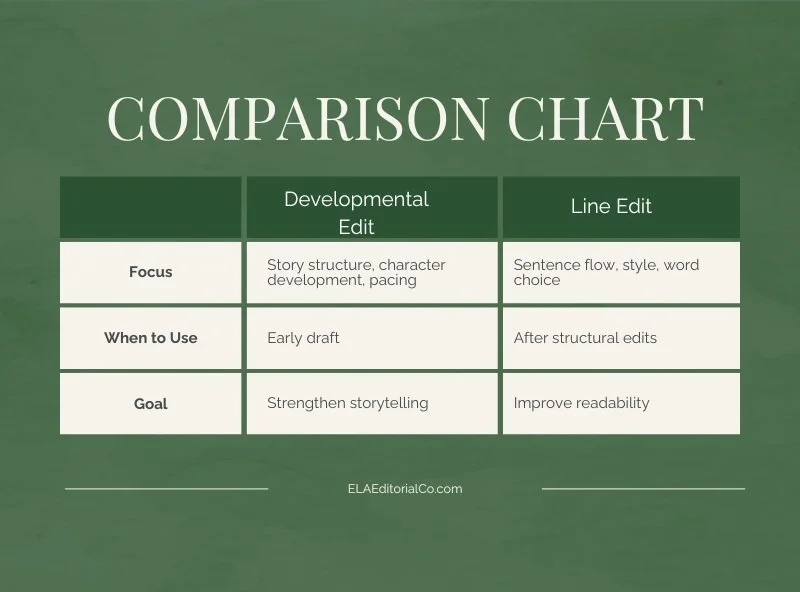
Learn more about different types of editing from Writer’s Digest.
Do You Need Both Developmental and Line Editing?
Most books will benefit from both types of editing services at different stages. Developmental editing ensures the foundation of your story is strong, while line editing refines your prose for a polished draft.
If you’re unsure which editing service your manuscript needs, consider where you are in the writing process.
If your story structure, plot, and characters still need work, developmental editing is the best starting point for you.
If your manuscript is structurally sound but needs stylistic improvements, line editing is the right choice.
Learn more about our book editing services to determine which one best fits your needs.
How to Hire the Right Editor for Your Book
Finding the right book editor is one of the most important steps in refining your book and getting it ready to publish. Here are a few thoughts to consider:
For developmental editing, look for an editor who has expertise in story structure, pacing, and character development.
For line editing, choose an editor who is skilled in language refinement, readability improvement, and tone consistency.
If you're a busy professional who is balancing work and writing, hiring a book editor who understands your unique challenges can make the editing process smoother and more effective.
Questions to Ask Before Hiring an Editor
Before committing to an editor, you’ll want to ask the right questions to ensure you’ve found the right fit. Doing so can save you time, money, and frustration, while also ensuring your book receives the care it deserves. Here are a few questions I advise every writer to ask:
Do you have experience with my genre?
(Why is this important? Editing techniques vary across fiction, memoirs, and nonfiction, so you want someone familiar with your book’s style.)
What is your editing process and turnaround time?
(Why is this important? Make sure their approach and timeline align with your goals.)
What are your pricing options?
(Why is this important? Understanding costs upfront helps you appropriately budget for editing.)
Do you offer sample edits?
(Why is this important? A sample edit allows you to gauge the editor’s style and compatibility with your work.)
Next Steps: Get Expert Editing Help
Knowing when to hire a book editor depends on your manuscript’s progress. If you're ready to refine your book and move toward publication, ELA Editorial Co. is ready to help!
Book a Free Editing Consultation
Let’s connect to discuss your book’s needs and tailor our editorial services to your goals.